Segway Ninebot E3 Pro review
The least exciting scooter we recommend, and the one we recommend most often to people who do not want to think about scooters. A published weather rating at this price is rarer than it should be.
By Ryder M. · Published October 26, 2026
Kick & Volt earns a commission when you buy through our Amazon links, at no extra cost to you. It never changes what we recommend or how we rank it — read the full disclosure.
The verdict
The short answer
Buy it if your round trip is under about 12 miles, you want a weather rating you can look up rather than guess at, and you would rather buy from the brand with the most parts and service coverage than chase a spec sheet. Skip it if your route has a sustained climb, you need more than 19 mph, or you are near the 265 lb payload ceiling.
The conservative budget pick: 17.2 measured miles, IPX5, and the largest service network in the category behind it.
Where this model is sold on Amazon, the product shot below comes from its Amazon listing. The banner at the top of the page is a licensed stock image chosen to illustrate the category, not a photograph of this machine. We have not ridden or owned one — every figure below is attributed to the third party that published it.
Claimed versus measured
| Specification | Manufacturer claim | Independently measured |
|---|---|---|
| Range | Not published | 17.2 milesMeasured (eRideHero, Sep 2026) |
| Top speed | Not published | 19.3 mphMeasured (eRideHero, Sep 2026) |
| Scooter weight | Not published | 40.1 lbMeasured (eRideHero, Sep 2026) |
| Max rider weight | Not published | 265 lbMeasured (eRideHero, Sep 2026) |
| Motor | Not published | 400 WMeasured (eRideHero, Sep 2026) |
| IP rating | IPX5Claim (eRideHero, Sep 2026) | Not published |
A published IPX5 rating is the reason this scooter exists
Segway publishes an IPX5 rating for the E3 Pro (eRideHero, Sep 2026). At this end of the market that is unusual: most budget scooters publish no IP figure at all, which means nothing about water ingress is guaranteed and the scooter has to be treated as fair-weather only.
IPX5 is tested against low-pressure water jets from any direction, which is the practical threshold for riding on a wet road — the spray that comes off your own front wheel arrives under pressure, not as a gentle drizzle. IP ratings and wet weather works through what each digit is actually tested against, including the fact that no consumer publication owns an ingress rig, so every IP rating in circulation is the manufacturer’s own claim rather than a measurement.
Why it matters more than the headline specs: water in the controller or the battery management board is the failure that ends a scooter rather than inconveniencing it. Tires wear, pads glaze, cables stretch — all cheap. A soaked controller is the end. That is why a published sealing figure is one of the four durability proxies in how to judge scooter durability honestly, and why this scooter anchors the best scooters under $500 rather than the cheaper machines around it.
17.2 measured miles, and what that actually covers
eRideHero rode it until it shut down and recorded 17.2 miles (eRideHero, Sep 2026). That is a measurement rather than a claim, which already separates it from most scooters at this price — across the twelve-model claimed-versus-tested study this site is built on, advertised range came in at an average of 71% of the printed figure and as low as 53% (Rider Guide, Sep 2026).
Plan around roughly 30% less than any measured number to allow for cold weather, gradients and rider weight, and 17.2 miles becomes a comfortable 12-mile round trip — a six-mile each-way commute with margin left over. The arithmetic is in how far you can actually commute.
Against the rest of the budget band that is mid-table and honest. The NAVEE GT3 Pro measured 23.3 miles and the NIU KQi 300X 26.8, both at a higher price; the GoTrax G4 measured 14.6 at a listed $439 (eRideHero, Sep 2026) (Rider Guide, Sep 2026). The E3 Pro sits between the cheapest measured scooter and the value leaders, which is exactly where its price sits.
19.3 mph and 400 W are the real compromises
Two measured figures set the ceiling on what this scooter is for. 19.3 mph (eRideHero, Sep 2026) holds a bike lane and keeps pace with urban traffic at junctions, and it sits just under the 20 mph cap that many US jurisdictions apply to e-scooters — which makes it one of the models in the street-legal round-up. If your route includes a stretch of open road where everything else is doing 30 mph, this is the wrong scooter and the scooters that measured 30 mph is the right page.
400 W is the figure we would push back on hardest. Manufacturer guidance, consistent across several makers, puts roughly 500 W and up at a 5 to 10% residential slope and 1,000 W and up at a genuinely steep street (Hiboy, Sep 2026) (Levy Electric, Sep 2026). 400 W sits just under the lower line, so a moderate hill with a heavier rider aboard will have it working visibly hard. The wattage bands are in how steep a hill it can climb, and watts and torque explained covers what the figure does and does not predict.
The payload rating is 265 lb (eRideHero, Sep 2026) — the industry default, with no headroom for a rider near it carrying a bag. If you are above about 230 lb loaded, the 250 lb round-up is the page to read first.
The specification Segway does not publish
No brake type appears for the E3 Pro in the test data we found. That is the one real hole in an otherwise unusually complete row, and it is worth naming because this is the Segway model whose row is least complete — the Ninebot Max G3, by contrast, is the only mainstream commuter in our registry with no missing cells at all (eRideHero, Sep 2026).
What the data does give is dual rubber dampening front and rear, plus 10-inch tubeless tires (eRideHero, Sep 2026). Rubber dampening is the mildest form of suspension there is — a step above a rigid frame and well below a hydraulic fork — which is consistent with the price and with the 40.1 lb weight. Suspension explained ranks the types, and the suspension round-up covers the models that have more.
Our position on brakes does not soften for a budget scooter: two real friction brakes, not one plus regeneration, because regenerative braking is an assist that depends on the controller and the battery working. The brake hardware ranking sets out why, and the hydraulic-brake round-up is for riders who want the question settled before they buy. On the E3 Pro, ask the seller.
The argument that is not a specification
The reason we keep recommending this scooter is not on its spec sheet. Segway runs the largest parts and service network in this category — not a measurement, an observation, and we report it as exactly that on the Segway brand page.
It matters because of how this market is shaped. More than half the models in our registry come from brands that sell direct — VMAX, EMOVE, Varla, Kaabo, Nami, Solar, JackRabbit, Hiley, INMOTION — which means one support relationship and a parts supply tied to that one company still being there. Segway, NIU, NAVEE and GoTrax sell through conventional retail, so consumables and replacements move through normal channels. Repairs, parts and service works through what each channel means the day something breaks.
For a first scooter, or for a buyer who wants to stop thinking about the decision once it is made, that is worth more than three measured miles. It is also the honest limit of what we can say: we hold no warranty-performance, repair-turnaround or failure-rate data for Segway or anybody else, and we will not characterize any of them without it.
What to buy instead
NAVEE GT3 Pro if you want more range for a little more money: 23.3 measured miles, 20.6 measured mph and the same IPX5 rating, at 48.5 lb (eRideHero, Sep 2026). It is the best value in our measured data and it carries the value pick on best for the money.
GoTrax G4 if the budget is tighter: 20 mph and 14.6 measured miles for a listed $439 (Rider Guide, Sep 2026), at 37.4 lb. Less range, no published IP rating, and the cheapest honest entry point — the G4 review has the detail.
Segway Ninebot Max G3 if you can stretch: 24.9 measured miles, 28 measured mph, a 286 lb payload rating, IPX6 and dual adjustable hydraulic suspension (eRideHero, Sep 2026). It is the most complete mainstream commuter in our data and the one we would buy with our own money — the Max G3 review.
GoTrax A5 if what you actually want at this price is a seat rather than a stand-up deck. A listed $300 with a built-in saddle, a claimed 15.5 mph and a 220 lb ceiling, every figure untested — the GoTrax A5 review is the honest account of it.
What we do not know
Scooters that clear that bar
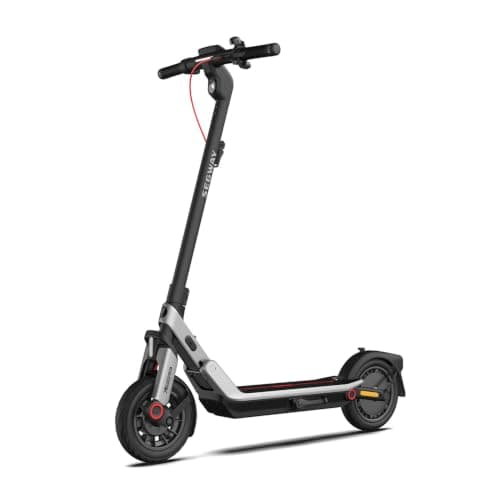
The conservative budget pick: 17.2 measured miles, IPX5, and the largest service network in the category behind it.
#ad How we are funded · Price as of November 14, 2026
Alternatives
- Best electric scooters under $500
- Segway: what the measured data says
- Segway Ninebot Max G3 review
- Best street-legal electric scooters
A price written into the text is what a dated source listed when we read it. The live figure is the one inside the buy button — see how we are funded.
Frequently asked questions
▸How far does the Segway Ninebot E3 Pro really go?
eRideHero measured 17.2 miles riding it until it shut down. Plan around roughly 30% less to allow for cold weather, hills and rider weight — which makes a 12-mile round trip comfortable.
▸Can you ride the Segway E3 Pro in the rain?
It carries a manufacturer IPX5 rating, which is tested against low-pressure water jets from any direction and is the practical threshold for wet roads. No scooter is waterproof, and the rating is a design envelope rather than a promise — dry it before charging.
▸Is the Segway E3 Pro good on hills?
Modestly. Its 400 W motor sits just under the roughly 500 W that makers consistently cite for 5 to 10% residential gradients, so a moderate hill with a heavier rider will have it working hard. It is not the scooter for a route with a sustained climb.
▸How fast is the Segway Ninebot E3 Pro?
19.3 mph measured. That sits just under the 20 mph cap many US jurisdictions apply to e-scooters, which is part of why it is one of the easier models to ride legally.
▸What is the weight limit on the Segway E3 Pro?
265 lb, the industry default. That leaves no headroom for a rider near it carrying a bag — if you are above about 230 lb loaded, look at machines rated 286 lb and up.
Read next
Kick & Volt does not ride or bench-test scooters. Every real-world figure on this page is attributed to the third party that measured it — how we research this.