The best seated electric scooters for hills
A seated scooter starts a climb 30 to 70 pounds heavier than a stand-up one. That changes the arithmetic, and most of these machines have the power for it.
By Ryder M. · Published September 29, 2026
Kick & Volt earns a commission when you buy through our Amazon links, at no extra cost to you. It never changes what we recommend or how we rank it — read the full disclosure.
Why a seat changes the hill arithmetic
Hill performance is a power-to-weight problem, and a seated scooter changes the weight side of it twice over.
The machine is heavier. The seated models here run from a claimed 37 lb to 153.7 lb, against 26 to 65 lb for a typical stand-up commuter. On the heavier ones that is an extra 80 lb going up the hill before the rider is even counted.
The rider is usually heavier too. Seated scooters carry higher payload ratings and attract riders who need them — 330 lb and 352 lb are common in this category. Rider weight is the single biggest variable in climbing: a 200 lb rider on a 350 W scooter sees materially worse uphill performance than a 120 lb rider on the same machine (NAVEE, Sep 2026).
The practical consequence is that the usual wattage guidance should be read one band stricter here. Fortunately most seated machines are built with that in mind — four of the five below clear 749 W, and two clear 1500 W.
| # | Product | Best for | Score | Price |
|---|---|---|---|---|
| 1 | 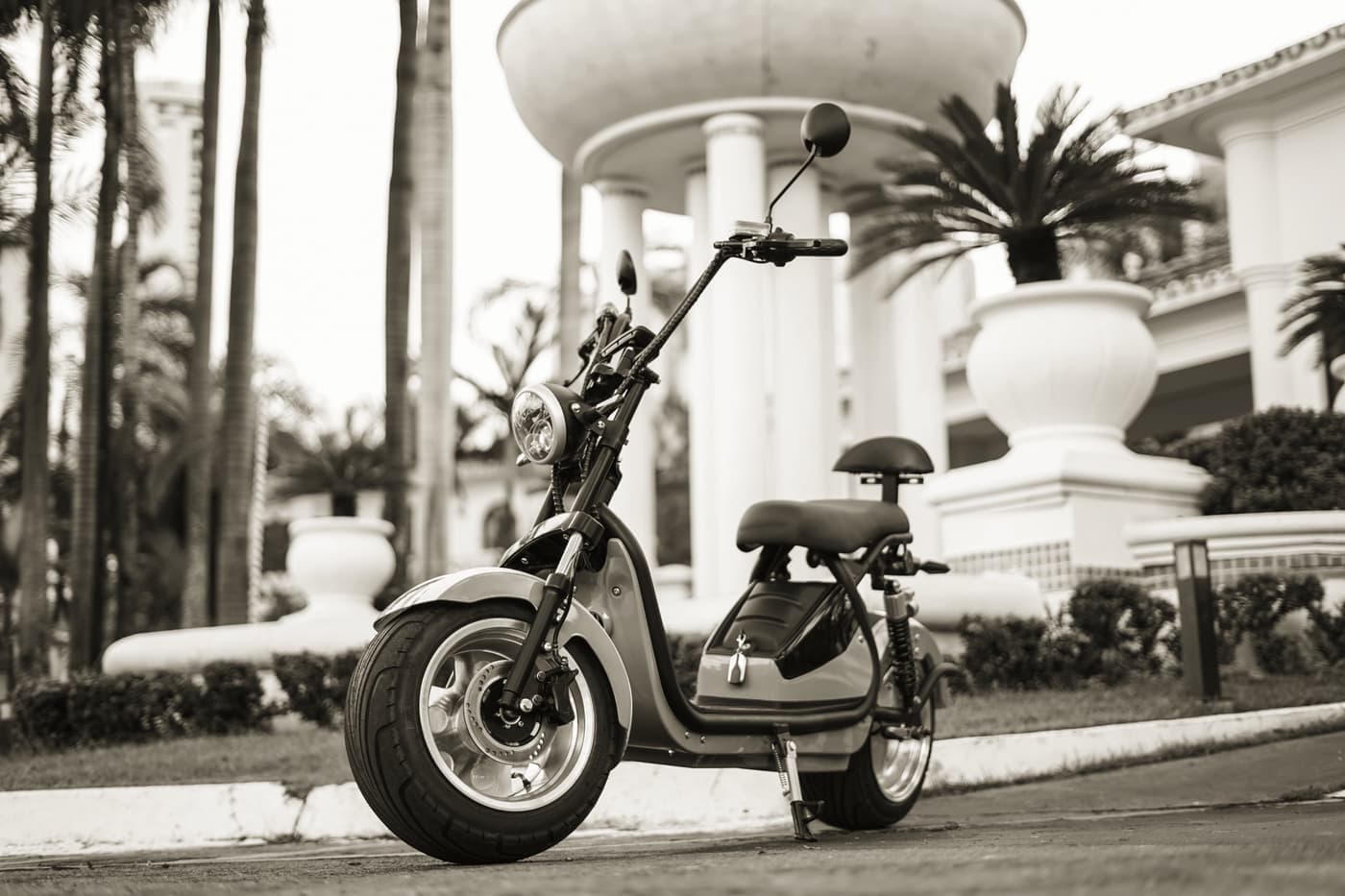 EMOVE RoadRunner Pro V2A claimed 4000 W nominal. Nothing you can legally ride up will trouble it. EMOVE RoadRunner Pro V2A claimed 4000 W nominal. Nothing you can legally ride up will trouble it. | Top-end seated | 7.6 | |
| 2 | isinwheel H7A claimed 1500 W for a listed $699 — past the 1000 W threshold on paper, unverified in practice. | Most spec per dollar (all claimed) | 6.7 | |
| 3 | EMOVE RoadRunner V3Dual 500 W, so 1000 W combined and split across two wheels — traction as well as power. | Best seated all-rounder | 5.9 | |
| 4 |  JackRabbit XG Pro749 W in a 37 lb machine. The best power-to-weight ratio here by a distance. JackRabbit XG Pro749 W in a 37 lb machine. The best power-to-weight ratio here by a distance. | Lightest seated machine | 6.2 | |
| 5 |  EMOVE Cruiser V232.2 mph measured with hydraulic brakes — and brakes matter as much as watts on a hill. EMOVE Cruiser V232.2 mph measured with hydraulic brakes — and brakes matter as much as watts on a hill. | Best for heavy riders | 7.8 |
Scores are computed from published specifications using the rubric on our research methodology page. Tap any row to jump to the full write-up.
Every pick in full
Each model below lists what the maker publishes, what an independent tester measured, and the trade-off you accept by choosing it. Nothing here is perfect.
EMOVE RoadRunner Pro V2
A claimed 4000 W nominal. Nothing you can legally ride up will trouble it.
- Range:
- ~55 milesMeasured (Rider Guide, Sep 2026)
- Top speed:
- 55 mphMeasured (Rider Guide, Sep 2026)
- Weight:
- 153.7 lbMeasured (Rider Guide, Sep 2026)
- Max rider:
- 352 lbMeasured (Rider Guide, Sep 2026)
What is good
- DOT-spec hydraulic brakes with 203 mm rotors — the only braking hardware appropriate at these speeds
- 352 lb payload with the frame to justify it
- A measured ~55 miles against a 40-75 mile claim is a respectable delivery
What you give up
- Our two sources disagree on weight: 135 lb versus 153.7 lb. Assume the heavier number
- 60 mph on a scooter is a decision about risk, not about specs
- A listed $3,795 and a machine you will never move without a ramp
Listed at $3,795Measured (Rider Guide, Sep 2026) when we read that page. We do not publish live prices — check the current one before you buy.
isinwheel H7
A claimed 1500 W for a listed $699 — past the 1000 W threshold on paper, unverified in practice.
- Range:
- 43 milesMeasured (Rider Guide, Sep 2026)
- Top speed:
- 35 mphMeasured (Rider Guide, Sep 2026)
- Weight:
- 111.3 lbMeasured (Rider Guide, Sep 2026)
- Max rider:
- 330 lbMeasured (Rider Guide, Sep 2026)
No independent range test for this model has been published as of September 2026. Applying the category’s measured 71% average to the 43 mile claim suggests roughly 30.5 real miles — an estimate from the claimed-versus-tested study, not a measurement of this scooter.
What is good
- A claimed 1500 W and 330 lb rating at a listed $699 undercuts everything else here
- Hydraulic disc braking is the right hardware for 35 mph and 111 lb
- The claimed spec is a genuine value case if it holds
What you give up
- No independent test of range, speed or braking published as of September 2026
- 111.3 lb — this is furniture, not a scooter you move by hand
- Every figure on this row is the maker's. Weigh it accordingly
Listed at $699Measured (Rider Guide, Sep 2026) when we read that page. We do not publish live prices — check the current one before you buy.
EMOVE RoadRunner V3
Dual 500 W, so 1000 W combined and split across two wheels — traction as well as power.
- Range:
- 50 milesMeasured (Rider Guide, Sep 2026)
- Top speed:
- 34 mphMeasured (Rider Guide, Sep 2026)
- Weight:
- 77 lbMeasured (Rider Guide, Sep 2026)
- Max rider:
- 330 lbMeasured (Rider Guide, Sep 2026)
No independent range test for this model has been published as of September 2026. Applying the category’s measured 71% average to the 50 mile claim suggests roughly 35.5 real miles — an estimate from the claimed-versus-tested study, not a measurement of this scooter.
What is good
- 77 lb is genuinely light for a moped-style seated scooter
- Dual 500 W motors put it well past the 1000 W hill threshold
- XTECH hybrid hydraulics are proper braking hardware for 34 mph
What you give up
- 50 miles is a claim. At the 71% category average that is roughly 36 real miles
- No independent range or speed test published as of September 2026
- The seat is built in — you cannot convert it back to a stand-up scooter
Listed at $1,695Measured (Rider Guide, Sep 2026) when we read that page. We do not publish live prices — check the current one before you buy.
JackRabbit XG Pro
749 W in a 37 lb machine. The best power-to-weight ratio here by a distance.
- Range:
- 48+ milesMeasured (Rider Guide, Sep 2026)
- Top speed:
- 20 mph (24 mph off-road mode)Measured (Rider Guide, Sep 2026)
- Weight:
- 37 lbMeasured (Rider Guide, Sep 2026)
- Max rider:
- 275 lbMeasured (Rider Guide, Sep 2026)
No independent range test for this model has been published as of September 2026. Applying the category’s measured 71% average to the 48 mile claim suggests roughly 34.1 real miles — an estimate from the claimed-versus-tested study, not a measurement of this scooter.
What is good
- 37 lb with a seat — nothing else in the seated category is close
- Real mechanical disc brakes front and rear
- 749 W is more climbing power than most stand-up commuters
What you give up
- A listed $2,249 is a lot for 20 mph
- 48+ miles is a claim with no independent test published
- It rides like a tiny bike, not a scooter — try before you commit
Listed at $2,249Measured (Rider Guide, Sep 2026) when we read that page. We do not publish live prices — check the current one before you buy.
EMOVE Cruiser V2
32.2 mph measured with hydraulic brakes — and brakes matter as much as watts on a hill.
- Range:
- 46.3 milesMeasured (eRideHero, Sep 2026)
- Top speed:
- 32.2 mphMeasured (eRideHero, Sep 2026)
- Weight:
- 74 lbMeasured (eRideHero, Sep 2026)
- Max rider:
- 352 lbMeasured (eRideHero, Sep 2026)
What is good
- 352 lb payload with 46.3 miles independently measured — not a claim, a test result
- Hydraulic XTECH brakes, which is what 32 mph and a heavy rider need
- The best combination of payload, range and braking in our whole dataset
What you give up
- 74 lb
- No IP rating published in the test data we sourced
- 32.2 mph is fast enough that a helmet stops being optional
The gradient thresholds
| Gradient | What it takes | What that feels like |
|---|---|---|
| Under 5% | Any working scooter | A gentle rise you barely notice in a car |
| 5-10% | 500 W and up | A typical residential street with a slope |
| 10-15% | Good torque plus rider input | Most standard scooters top out here |
| 15-20% | 1000 W and up | A genuinely steep street |
| Over 20% | 1500 W and up, plus dual motors | San Francisco territory |
Wattage thresholds from manufacturer engineering guidance (Hiboy, Sep 2026) (Levy Electric, Sep 2026). Treat them as vendor claims: every one of these companies also sells a scooter it would like to sell you.
Add three to five percentage points to your requirement if you weigh significantly more than the roughly 165 lb standard testing weight (Levy Electric, Sep 2026), and remember that a manufacturer’s maximum-incline rating is measured with a light rider on a full battery in ideal conditions — real-world climbing is typically around 60% of the rated maximum (Levy Electric, Sep 2026). Our hill-gradient guide works through this in full.
Dual motors beat raw wattage on a wet climb
The EMOVE RoadRunner V3’s dual 500 W setup is 1000 W combined, which is less than the isinwheel H7’s claimed 1500 W — but it is split across two driven wheels. On a wet or loose gradient a single driven wheel can simply spin, and two cannot as easily. That is the real argument for dual motors and we make it at length in the dual-motor round-up.
Watts are a proxy, not the answer
Torque is what moves a machine against gravity, not power, and it depends on gearing, controller output and battery voltage as well as wattage (Levy Electric, Sep 2026). Essentially nobody publishes a torque figure. Our watts and torque explainer covers why two machines with the same wattage can climb differently.
The part everyone forgets: going back down
A hill is a two-way problem. Taking 150 lb of machine plus 250 lb of rider down a 15% grade puts far more demand on the brakes than the climb puts on the motor, and brake fade on a long descent is a real failure mode.
This is why the EMOVE Cruiser V2 and RoadRunner Pro V2 are on this page despite not having the highest wattage: hydraulic XTECH and full hydraulic DOT brakes with 203 mm rotors respectively (eRideHero, Sep 2026) (Rider Guide, Sep 2026). Full hydraulic systems are the strongest and most consistent type and need the least lever force (eRideHero, Sep 2026), which matters when you are modulating them for a mile of descent.
If you live somewhere steep, weight the braking hardware at least as heavily as the motor — the detail is in our brakes guide, and the inspection routine for a heavy machine is in frame and brake checks.
What we do not know
Frequently asked questions
▸Can a seated electric scooter climb hills?
The powerful ones, yes — four of the five here have 749 W or more and two claim 1500 W or above. The complication is that seated machines are heavier, so the usual wattage guidance should be read one band stricter.
▸How many watts does a seated scooter need for hills?
Read the standard thresholds one band up because of the extra machine weight: treat 1000 W as the floor for anything above a 10% grade, and add three to five percentage points to your requirement if you are heavier than about 165 lb.
▸Are dual motors better than one big motor on hills?
Usually, because traction is split across two driven wheels. On a wet or loose climb a single driven wheel can spin where two will not, even if the combined wattage is lower.
▸What about going downhill?
It is the harder problem. A heavy seated machine with a heavy rider demands far more of the brakes on descent than of the motor on the climb. Prioritize hydraulic braking if you live somewhere steep.
Read next
Kick & Volt does not ride or bench-test scooters. Every real-world figure on this page is attributed to the third party that measured it — how we research this.