Electric scooter suspension explained
Three mechanisms, two positions, and a lot of listings that say “dual suspension” without saying what kind. Here is what each actually does and when the money is worth spending.
By Ryder M. · Published October 10, 2026
Kick & Volt earns a commission when you buy through our Amazon links, at no extra cost to you. It never changes what we recommend or how we rank it — read the full disclosure.
The short answer
You need suspension if your roads are broken; you do not if they are smooth and you want a light scooter. The best setup in our data is the Segway Ninebot Max G3’s dual adjustable hydraulic on 11-inch tires (eRideHero, Sep 2026); the most capable is the Segway ZT3 Pro’s long-travel hydraulic on 12-inch tires (eRideHero, Sep 2026). The counter-example is the NIU KQi Air, which has no suspension at all and is the lightest usable commuter we hold data for at 26.4 lb. Suspension is weight, and weight is the thing you carry.
Three mechanisms
- Rubber dampening. A rubber block or bushing that compresses. Cheap, light, maintenance-free, and the least effective — it takes the edge off a seam, not off a pothole. The Segway Ninebot E3 Pro runs dual rubber dampening front and rear (eRideHero, Sep 2026).
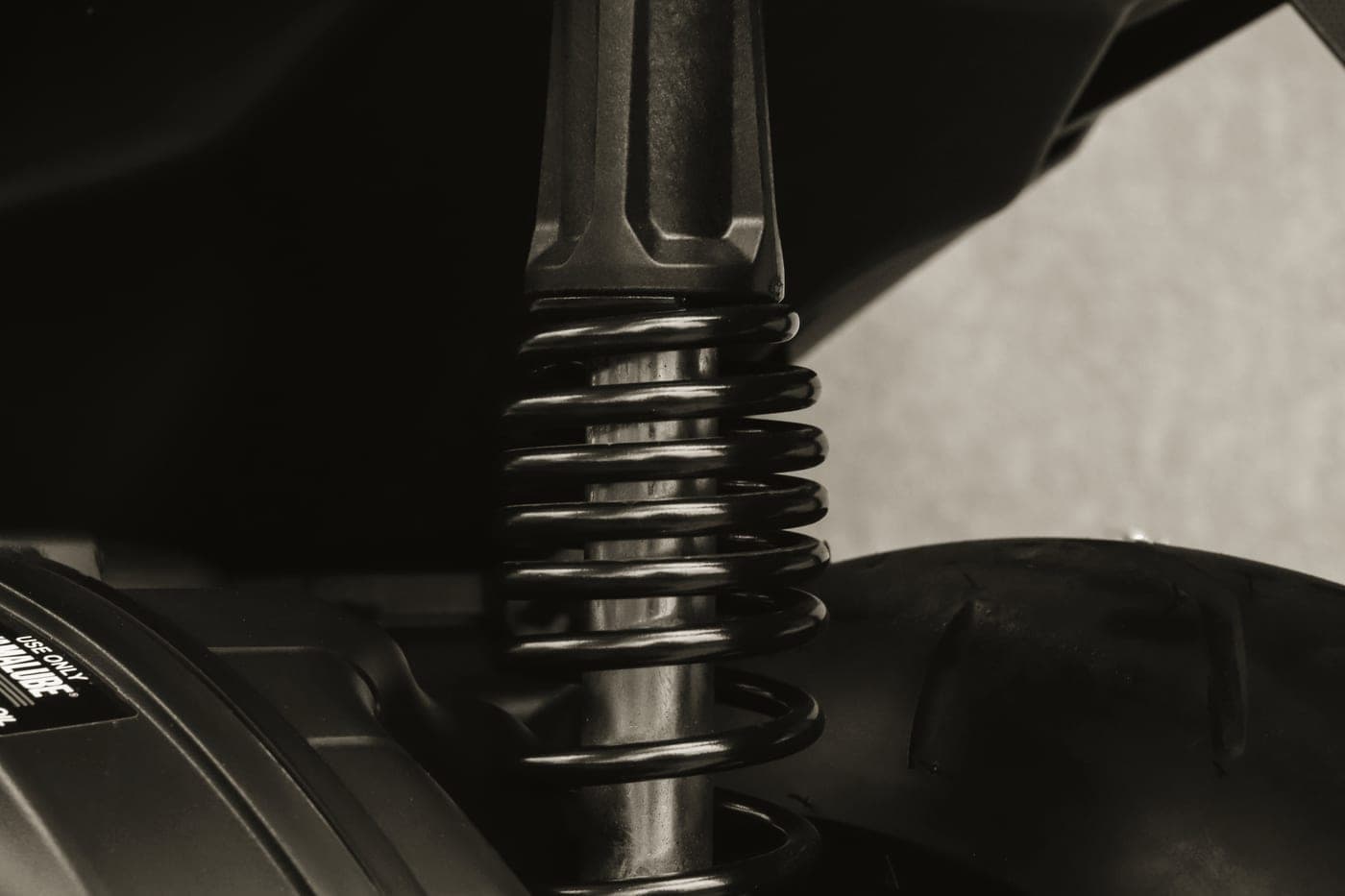
- Spring. A coil that compresses and rebounds. More travel than rubber, more effective over real bumps, and it bounces if it has no damper — which most scooter springs do not. The NAVEE GT3 Pro pairs a front fork with a rear spring (eRideHero, Sep 2026).
- Hydraulic. A damped unit that controls both compression and rebound. The only mechanism that behaves like real vehicle suspension, the heaviest, and the one that costs money. The NIU KQi 300X has it at the front only; the Max G3 has it at both ends and adjustable.
Listings regularly say “dual suspension” and name neither mechanism. When the mechanism is unstated, assume rubber or an undamped spring — nobody hides hydraulics.
Front, rear or dual
Front suspension protects your hands and the steering; rear suspension protects the deck and your feet, and on a scooter it also protects the hub motor, which is bolted into the rear wheel and is the single most expensive thing on the machine. Dual is better and costs weight at both ends.
If you can only have one, front is the more useful on a commuter — hand and wrist fatigue from road buzz is the thing riders actually complain about. If your route is genuinely rough, dual is not a luxury, and the models that have it are in the suspension round-up.
Do you actually need it?
Three honest answers:
- Smooth asphalt, short commute, carry at both ends: no. Large self-healing tires do most of the work and you save several pounds. The NIU KQi Air makes this case at 26.4 lb with 24.2 measured miles and no suspension at all (eRideHero, Sep 2026).
- Normal city pavement with seams, patches and curb transitions: front at minimum, dual if it is in budget.
- Gravel, grass, trail or genuinely broken roads: dual, hydraulic, long-travel, on 11-inch tires or bigger. That specification lives in the off-road category rather than the commuter one.
What our models publish
Four setups, from a dual adjustable hydraulic commuter to a long-travel hydraulic all-terrain machine, every specification below as the testers recorded it.
28 mph measured, IPX6, dual disc brakes and 286 lb of payload — the most complete mainstream commuter in the data.

24.7 mph and 22.7 measured miles with the best ride quality in its payload bracket — the comfortable all-terrain option.

23.3 measured miles and an IPX5 rating from a scooter positioned at the budget end — the best value in the measured data.
IP66, 700 W and 26.7 mph at 46 lb — the most capable scooter in this data that is still genuinely portable.
What adjustable adds
Adjustable suspension lets you preload the spring or alter the damping for your weight. Non-adjustable suspension is tuned for a nominal rider, which means a 140 lb rider rides on suspension that barely moves and a 250 lb rider rides on suspension that is already compressed before they hit anything. The Max G3 is the only model in our registry that publishes adjustable units at both ends (eRideHero, Sep 2026), and for a rider at either end of the weight range that matters more than the mechanism does.
It matters most for heavier riders, which is why the 250 lb round-up and frame and brake checks both come back to it. Suspension that is permanently bottomed out is not suspension, and it transmits load into the stem and folding joint instead.
Suspension and tires together
These two specifications do the same job and are usually sold separately. A 12-inch self-healing tubeless tire on long-travel hydraulics, as on the ZT3 Pro, is a different vehicle from a 9-inch tire on rubber blocks — but a large air tire at a sensible pressure is itself a suspension component, which is why the suspension-free NIU KQi Air is not unrideable. Read tires explained alongside this page; the two decisions should be made at once.
One last trade worth naming. Every pound of suspension is a pound you lift onto a train, and the heaviest model on this page is 65.5 lb against the lightest at 26.4 lb. If the scooter has to be carried, lightweight and folding is the round-up that weights the other side of it.
What we do not know
Frequently asked questions
▸Do I need suspension on an electric scooter?
Only if your roads need it. On smooth asphalt, large self-healing tires do most of the job and skipping suspension saves several pounds. On patched city pavement, front suspension at minimum; on gravel or trail, dual hydraulic.
▸What is the best type of scooter suspension?
Hydraulic, because it damps both compression and rebound rather than just absorbing a bump. Springs are next, rubber dampening is the least effective. Adjustable hydraulic at both ends is the best setup in our data.
▸Is dual suspension worth it?
On rough surfaces, yes — the rear unit protects the deck and the hub motor as well as your feet. On smooth roads it mostly adds weight. Be careful with the phrase: many listings say dual suspension without saying whether it is rubber, spring or hydraulic.
▸Can you add suspension to a scooter that has none?
Not meaningfully. Suspension mounts are part of the frame and fork design. The practical substitutes are a larger tire at a slightly lower pressure, and a different scooter.
Read next
Kick & Volt does not ride or bench-test scooters. Every real-world figure on this page is attributed to the third party that measured it — how we research this.