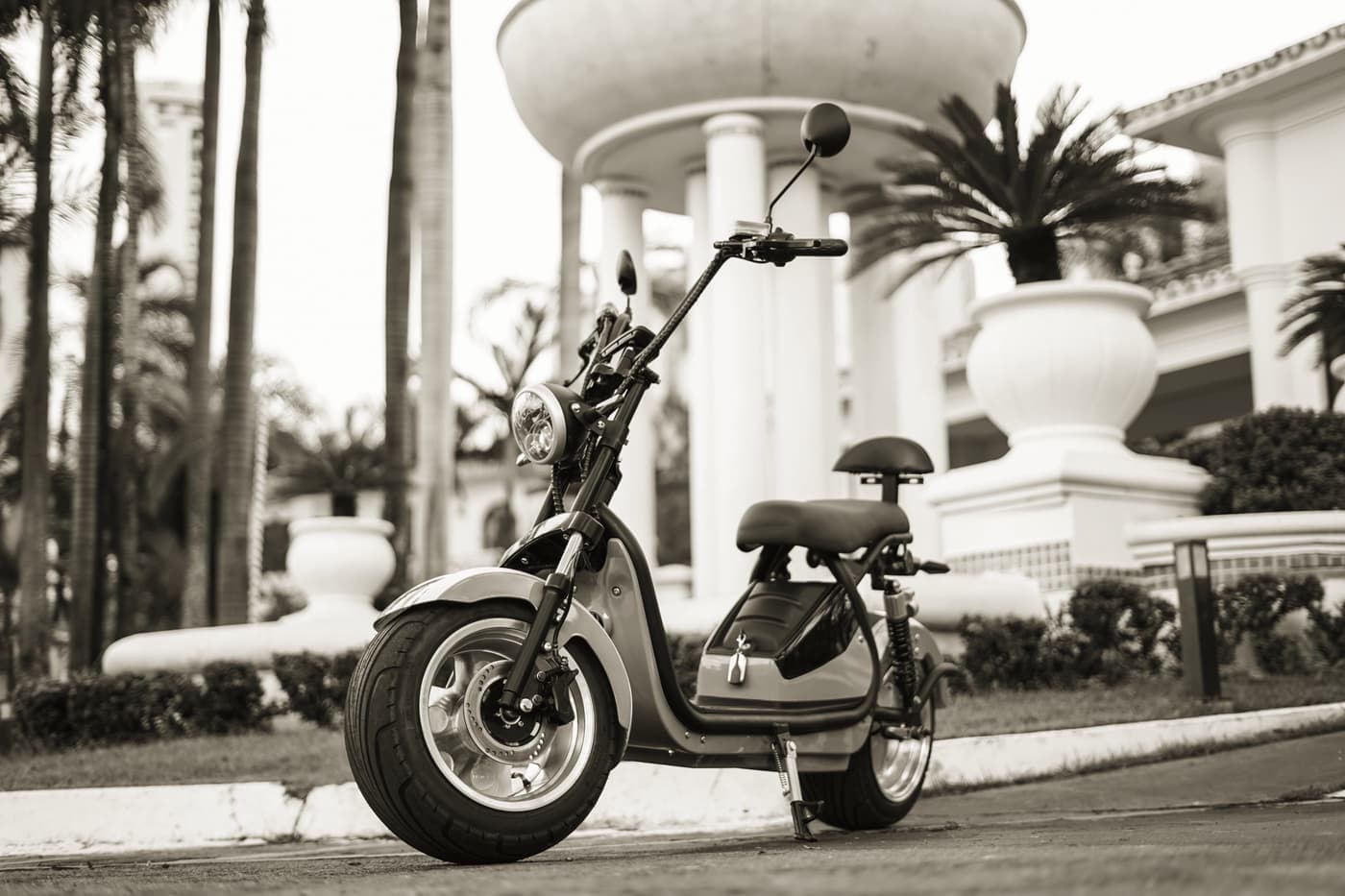
The best dual-motor electric scooters with a seat
Two driven wheels and somewhere to sit is a much rarer combination than the search results suggest. Three machines qualify, one of them only once you have bought the seat separately, and the honest answer for a lot of buyers is a single motor.
By Ryder M. · Published October 5, 2026
Kick & Volt earns a commission when you buy through our Amazon links, at no extra cost to you. It never changes what we recommend or how we rank it — read the full disclosure.
What had to be true
This page exists because “dual motor electric scooter with seat” is a real thing people type, and almost every page that answers it quietly cheats — by counting a universal clamp-on saddle as a seat, by counting a regenerative front hub as a second motor, or by listing machines nobody can buy. So the bar here is written down first, and applied before anything else:
- Two driven wheels. Two motors that both put power down. A single hub motor paired with an electronic or regenerative brake on the other wheel is a single-motor scooter, and we have a separate dual-motor round-up that explains why the distinction matters more on a wet climb than on a dry one.
- A seat the manufacturer sells for that exact model. Either a factory saddle built into the frame, or an accessory on the maker’s own parts list naming that model as compatible. A generic clamp-on from a marketplace listing does not count: a seat changes where your weight sits relative to the stem, and a part the maker never engineered for the frame is a different risk from a part it did.
- A published figure for range and speed. Measured by a named third party where that exists, and clearly labeled as the maker’s claim where it does not.
- Currently on sale. Re-checked in October 2026 before this page was written.
A three-machine market
Three machines clear all four. That is not an editing decision, it is the finding, and it is the single most useful thing on this page: if you have been searching for a week and getting lists of ten, those lists are padded.
What we do not know
The reason the market is this thin is structural rather than accidental. A seat and a second motor solve different problems. A seat is bought by people who want to sit down for a longer, slower journey, and the market answers them with moped-style frames and one big hub motor. A second motor is bought by people who want traction on loose or steep ground, and the market answers them with stand-up performance scooters where a seat gets in the way of shifting your weight. The overlap is small because the demand for the overlap is small — and the two EMOVE machines below exist because Voro Motors is one of the few makers that deliberately builds into it.
We ordered the three by how much scooter you get for the money, not by our published rubric score. The rubric weights portability at 20%, which on a page where every machine is between 77 and 154 lb mostly measures how heavy the battery is; and it rewards the RoadRunner Pro V2 for a 55 mph top speed that is the main reason most buyers should not pick it. Both rubric scores are still printed on every row below, so you can check the arithmetic against ours on the methodology page.
| # | Product | Best for | Score | Price |
|---|---|---|---|---|
| 1 | EMOVE RoadRunner V3Dual 500 W with a factory saddle and the lowest weight of the three, at a listed $1,695. | Best seated all-rounder | 5.9 | |
| 2 |  Varla Eagle One V2The only one with a measured braking distance, and the seat is a separate $159 part. Varla Eagle One V2The only one with a measured braking distance, and the seat is a separate $159 part. | Dual motors plus a factory seat option | 6.4 | |
| 3 | EMOVE RoadRunner Pro V2Dual motors, DOT hydraulics and a measured 55 mph. Buy it for the brakes, not the speed. | Top-end seated | 7.6 |
Scores are computed from published specifications using the rubric on our research methodology page. Tap any row to jump to the full write-up.
Every pick in full
Each model below lists what the maker publishes, what an independent tester measured, and the trade-off you accept by choosing it. Nothing here is perfect.
EMOVE RoadRunner V3
Dual 500 W with a factory saddle and the lowest weight of the three, at a listed $1,695.
- Range:
- 50 milesClaim (Rider Guide, Sep 2026)
- Top speed:
- 34 mphClaim (Rider Guide, Sep 2026)
- Weight:
- 77 lbClaim (Rider Guide, Sep 2026)
- Max rider:
- 330 lbClaim (Rider Guide, Sep 2026)
No independent range test for this model has been published as of September 2026. Applying the category’s measured 71% average to the 50 mile claim suggests roughly 35.5 real miles — an estimate from the claimed-versus-tested study, not a measurement of this scooter.
What is good
- 77 lb is genuinely light for a moped-style seated scooter
- Dual 500 W motors put it well past the 1000 W hill threshold
- XTECH hybrid hydraulics are proper braking hardware for 34 mph
What you give up
- 50 miles is a claim. At the 71% category average that is roughly 36 real miles
- No independent range or speed test published as of September 2026
- The seat is built in — you cannot convert it back to a stand-up scooter
Listed at $1,695Measured (Rider Guide, Sep 2026) when we read that page. We do not publish live prices — check the current one before you buy.
Varla Eagle One V2
The only one with a measured braking distance, and the seat is a separate $159 part.
- Range:
- 24.4 milesMeasured (Electric Scooter Insider, Oct 2026)Logged at 37.8 F with 1,063 ft of climbing — hard conditions, so treat it as a floor
- Top speed:
- 36.1 mphMeasured (Electric Scooter Insider, Oct 2026)197 lb rider
- Weight:
- 82 lbClaim (Electric Scooter Insider, Oct 2026)
- Max rider:
- 330 lbClaim (Electric Scooter Insider, Oct 2026)Varla's own recommendation is 265 lb or under
What is good
- 2,000 W across two wheels, and a tester measured 36.1 mph out of it
- A braking distance somebody actually measured: 2.0 m from 15 mph
- The seat is a factory part Varla sells for this exact model, not a universal clamp-on
What you give up
- The seat is a separate $159 purchase, so the real price is not the sticker
- IP54 is splash-only — the weakest weather rating of any scooter on this page
- 330 lb is the spec; Varla itself recommends staying under 265 lb, which is the number to plan around
Listed at $1,548Claim (Electric Scooter Insider, Oct 2026)The sale price shown against a $1,999 list when we read the test when we read that page. We do not publish live prices — check the current one before you buy.
EMOVE RoadRunner Pro V2
Dual motors, DOT hydraulics and a measured 55 mph. Buy it for the brakes, not the speed.
- Range:
- ~55 milesMeasured (Rider Guide, Sep 2026)
- Top speed:
- 55 mphMeasured (Rider Guide, Sep 2026)
- Weight:
- 153.7 lbMeasured (Rider Guide, Sep 2026)
- Max rider:
- 352 lbClaim (Rider Guide, Sep 2026)
What is good
- DOT-spec hydraulic brakes with 203 mm rotors — the only braking hardware appropriate at these speeds
- 352 lb payload with the frame to justify it
- A measured ~55 miles against a 40-75 mile claim is a respectable delivery
What you give up
- Our two sources disagree on weight: 135 lb versus 153.7 lb. Assume the heavier number
- 60 mph on a scooter is a decision about risk, not about specs
- A listed $3,795 and a machine you will never move without a ramp
Listed at $3,795Measured (Rider Guide, Sep 2026) when we read that page. We do not publish live prices — check the current one before you buy.
What the second motor buys a seated rider
More than it buys a standing one, and for a reason that has nothing to do with power.
When you stand on a scooter you are a live suspension component. You shift your weight forward onto the front wheel to load it for grip, back onto the rear to get the driven wheel to bite, and you do it continuously without thinking about it. Sit down and you give that up. Your mass is fixed, high, and mostly over the rear axle. On a dry road that is fine. On a wet painted line, a gravel shoulder, or a steep driveway, a single driven wheel with a seated rider on it is the exact situation where a scooter spins instead of moving.
Two driven wheels split that load. It is the same argument we make in the general dual-motor round-up, but it applies harder here, because the rider who most wants a seat is also the rider least able to correct a slip by moving.
The power side is simpler arithmetic. A seated scooter starts every climb 30 to 70 lb heavier than a stand-up one, because the seat, the post and the bigger frame all weigh something. Manufacturer engineering guidance puts 1,000 W as the threshold for grades above 10% (Hiboy, Sep 2026), and all three machines here clear it: dual 500 W on the RoadRunner V3, dual 1,000 W on the Eagle One V2, and a nominal 4,000 W on the RoadRunner Pro V2. The seated hill round-up works through what those thresholds mean once a rider’s own weight is in the sum.
What it costs you
Weight and range, in that order. The lightest machine on this page is 77 lb and the heaviest is 153.7 lb, which puts every one of them firmly in the park-it-where-you-use-it band described in our weight and fold guide. Two motors also draw more current, so matching a single-motor scooter’s range takes a bigger battery, which is more weight again. There is no version of this trade where you get the traction for free.
The seat is a line item, not a feature
This is the part that catches people out, and it is why the Eagle One V2 is written up here with an asterisk rather than left off.
The two EMOVE machines arrive with a saddle attached — it is part of the frame and part of the price. The Varla does not. Varla sells a seat and rack combo listed at $159, and its own compatibility note names the Eagle One V2.0 (Varla, Oct 2026). That is a genuine factory part for that exact scooter, which is why it clears our second rule. But it means the price you see on the scooter listing is not the price of a seated scooter, and if you are comparing it against the RoadRunner V3 on cost you have to add the seat to one side of the sum before the comparison means anything.
There is a second-order consequence worth naming. An accessory seat bolts to a frame and a rack designed for a standing rider. It will be higher, and further back, than the saddle on a purpose-built moped-style machine, and your knees end up somewhere the deck was not laid out for. We have not ridden either arrangement and will not pretend otherwise — but the geometry is not a detail, and the difference between a built-in and a bolt-on seat is exactly the subject of our detachable versus built-in seats guide. Read it before you spend the $159.
When one motor is the better buy
Often. Possibly most of the time, and we would rather say so than sell you a second motor you will never use.
If you are not climbing anything steep or loose
A single large hub motor in a seated frame is a well-solved problem and a much larger market, which means more choice and lower prices. The isinwheel H7 claims 1,500 W and a 330 lb rating at a listed $699 (Rider Guide, Sep 2026) — one motor, but more claimed wattage than the RoadRunner V3’s two combined, for roughly 40% of the money. The GoTrax A5 sits lower still. Both are in the seated-under-$1,000 round-up.
| Model | Range | Top speed | Weight | Max rider | Motor | Brakes | IP | Price |
|---|---|---|---|---|---|---|---|---|
| isinwheel H7 | 43 milesClaim | 35 mphClaim | 111.3 lbClaim | 330 lbClaim | 1500 WClaim | EABS + hydraulic discClaim | Not published | Check price |
| GoTrax A5 | 15.5 milesClaim | 15.5 mphClaim | 51 lbClaim | 220 lbClaim | 400 W (550 W peak)Claim | Not published | Not published | Check price |
| JackRabbit XG Pro | 48+ milesClaim | 20 mph (24 mph off-road mode)Claim | 37 lbClaim | 275 lbClaim | 749 W rear hubClaim | Mechanical disc, front and rearClaim | Not published | Check price |
Measured figures come from a named third-party test; Claim figures come from the manufacturer. Sources are listed under each model below. Price links are paid affiliate links. Empty specifications read “Not published” rather than being estimated.
The three single-motor seated machines a dual-motor buyer should price against before committing. Every figure in this table is the manufacturer’s: no publication we could find has independently tested range or speed on any seated scooter under $1,000.
If you have to get it through a door
The JackRabbit XG Pro is 37 lb with a built-in seat and a claimed 749 W rear hub (Rider Guide, Sep 2026). It is one motor and it is twice the price of the RoadRunner V3, and for somebody carrying a machine up a single flight it is still the better answer, because 37 lb against 77 lb is not a close call.
If the budget is the binding constraint
Dual-motor seated starts at a listed $1,695 and the cheapest route into a seat at all is under $500. If the gap matters, it matters more than the traction does; start at the seated-under-$500 page and the how-to-choose guide, and come back to this page when the budget has moved.
What nobody has measured
Three things, and they are the three you would most want.
Seated range. Every range figure on this page except two was produced with a standing rider or published by the manufacturer. Sitting changes your frontal area, which changes drag, which changes range — and no publication we read tests a scooter with its seat fitted. The RoadRunner V3’s 50-mile claim is untested; at the 71% average delivery measured across a twelve-model study (Rider Guide, Sep 2026) that points to roughly 35.5 real miles, which is an inference from other scooters, not a measurement of this one.
Hill performance. Not one of the three has a published gradeability test. Wattage is a proxy for climbing, and a good one, but it is not the thing itself. Our gradient guide is explicit about where the proxy stops working.
Braking, on two of the three. The Eagle One V2 is the exception, and it is the reason it is on this page rather than merely eligible for it: Electric Scooter Insider measured 2.0 meters to a stop from 15 mph (Electric Scooter Insider, Oct 2026). That is a number. The EMOVE machines publish brake hardware — XTECH hybrid hydraulics and DOT hydraulics on 203 mm rotors respectively (Rider Guide, Sep 2026) — which is the right hardware, but hardware is not a stopping distance. On machines this heavy that gap is the one we would most like closed, and the brakes guide explains why.
Prices on this site are never live. Where we quote one it is what a dated source listed when we read it, and the Varla seat is a separate purchase on top. Check the current figure before you buy, and see how we are funded.
Frequently asked questions
▸Are there any dual-motor electric scooters with a built-in seat?
Two that we can document: the EMOVE RoadRunner V3 (dual 500 W) and the EMOVE RoadRunner Pro V2 (dual motors, 4,000 W nominal), both with factory saddles (Rider Guide, Sep 2026). The Varla Eagle One V2 has dual 1,000 W motors and a seat Varla sells as a separate accessory for that model (Varla, Oct 2026), which is the third option and not quite the same thing.
▸Is a dual-motor scooter worth it if I am going to sit down?
It is worth more to a seated rider than a standing one on loose or wet ground, because a seated rider cannot shift weight onto the driven wheel to find grip. On dry pavement with gentle hills it is weight and money you will not feel the benefit of, and a single-motor seated scooter is the better buy.
▸How much does the Varla Eagle One V2 seat cost?
Varla’s seat and rack combo was listed at $159 when we read the page, with compatibility stated for the Eagle One V2.0 (Varla, Oct 2026). Add it to the scooter price before comparing the Eagle One against a machine that comes with a saddle.
▸What is the cheapest dual-motor scooter with a seat?
Of the three here, the EMOVE RoadRunner V3 at a listed $1,695 (Rider Guide, Sep 2026) is the cheapest with the seat already included. The Varla Eagle One V2 listed lower at $1,548 when Electric Scooter Insider tested it (Electric Scooter Insider, Oct 2026), but the seat is $159 extra. Prices move; check both before deciding.
▸Does a seat reduce an electric scooter's range?
Probably, and we cannot tell you by how much. Sitting changes your frontal area and so your drag, and it adds the weight of the seat and post. No publication we read tests a scooter with the seat fitted, so every range figure on this page comes from a standing test or a manufacturer claim.
Read next
Kick & Volt does not ride or bench-test scooters. Every real-world figure on this page is attributed to the third party that measured it — how we research this.