The best street-legal electric scooters
No scooter is street legal everywhere, because no two states define the category identically. What exists is a band of speed and power that stays inside almost every definition — and five machines that sit comfortably inside it.
By Ryder M. · Published October 6, 2026
Kick & Volt earns a commission when you buy through our Amazon links, at no extra cost to you. It never changes what we recommend or how we rank it — read the full disclosure.
The short answer
The NAVEE GT3 Pro is the pick — 20.6 mph and 23.3 miles, both measured, with a published IPX5 rating (eRideHero, Sep 2026). Around 20 mph is the band that sits comfortably inside the low-speed electric scooter definition essentially everywhere in the US, and 23.3 miles is an unusual amount of real range to get without leaving it. Nothing here is street legal by model name: legality is decided by top speed and motor power against your own state and city rules, and a 20 mph scooter simply stops raising the question.
The short answer
“Street legal electric scooter” is a search for reassurance, and the honest version of that reassurance is not a model name. It is a band: buy inside roughly 15 to 20 mph with a motor under about 750 W, and you are inside the low-speed scooter definition in essentially every US state that has written one. Buy above it and the answer becomes “it depends where you live”, which is a bad answer to discover after the purchase.
Every scooter on this page measured 20.6 mph or less, from a named tester rather than a spec sheet. That is the whole selection criterion, and it is why the list contains no exciting machines at all.
What makes a scooter street legal
Four variables decide it, and the order matters because the first two are the ones built into the scooter and cannot be changed after you buy:
- Top speed. The single most common defining threshold in US state law. A machine capable of 50 mph is not a scooter under any definition we are aware of.
- Motor power. Often a secondary threshold, and the reason a high-wattage machine can fall outside the category even when it is speed-limited in software.
- Where you ride it. Sidewalk, bike lane, road and park rules differ, and are usually set locally rather than by the state.
- Who is riding. Age minimums and helmet requirements, commonly state-level and often age-dependent.
Only the first two are purchase decisions. The other two are route and behaviour decisions you make every day, which is why our legality guide spends more time on how to check your own rules than on any list of models, and why the licensing guide covers what changes once you cross a threshold.
The band that stays legal
- Around 15-20 mph — comfortably inside the scooter definition essentially everywhere, and typically the speed at which bike-lane use is permitted. Every pick on this page lives here.
- 20-28 mph — still a scooter in most places, but local speed limits start to bite even where the vehicle class does not change. The Segway Max G3 at 28 mph measured and the NAVEE ST3 Pro at 24.8 sit in this band and are excellent scooters; they are not on this page because the question being asked is a narrower one.
- 30 mph and up — increasingly likely to exceed a state’s scooter definition.
- Above 45-50 mph — outside the scooter category anywhere in the US, with the registration, licensing and insurance questions that implies.
| # | Product | Best for | Score | Price |
|---|---|---|---|---|
| 1 |  NAVEE GT3 ProThe pick: 20.6 mph and 23.3 measured miles with IPX5, which is the most usable scooter that still sits in the safe band. NAVEE GT3 ProThe pick: 20.6 mph and 23.3 measured miles with IPX5, which is the most usable scooter that still sits in the safe band. | Best budget overall | 5.2 | |
| 2 |  NIU KQi Air20.1 mph measured, 24.2 miles and 26.4 lb. The least likely scooter on this site to attract a second look. NIU KQi Air20.1 mph measured, 24.2 miles and 26.4 lb. The least likely scooter on this site to attract a second look. | Carrying up stairs | 5.9 | |
| 3 | 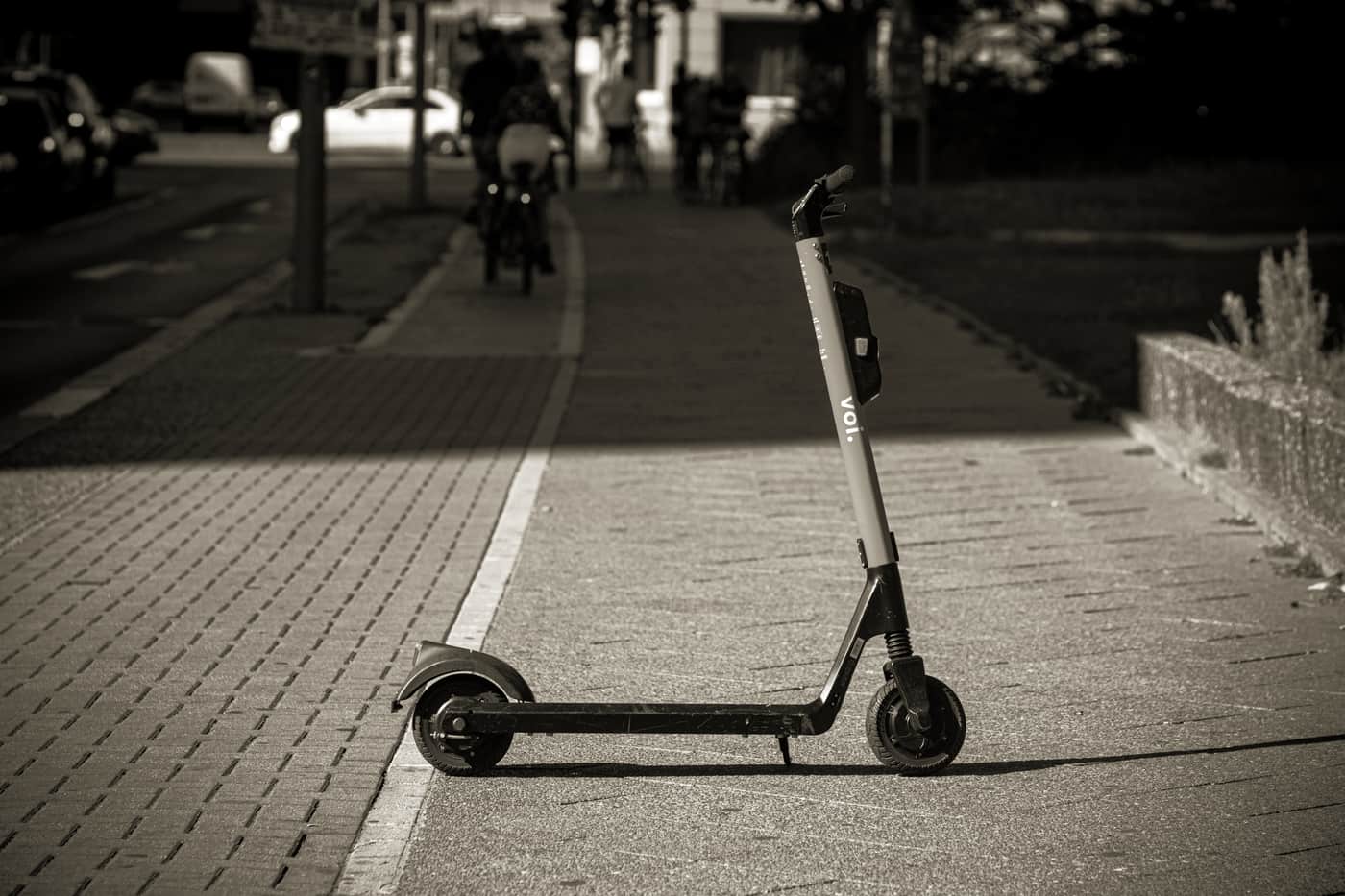 Segway Ninebot E3 Pro19.3 mph, IPX5, and the largest service network behind it if something needs fixing. Segway Ninebot E3 Pro19.3 mph, IPX5, and the largest service network behind it if something needs fixing. | Budget buyers who want support | 5.1 | |
| 4 |  GoTrax G420.0 mph measured at a listed $439 — the cheapest way to stay clearly inside the line. GoTrax G420.0 mph measured at a listed $439 — the cheapest way to stay clearly inside the line. | Best under $500 | 5.4 | |
| 5 | NIU KQi 100F17.4 mph and 300 W. Nothing about this machine comes near any threshold anywhere. | Short last-mile hops | 4.0 |
Scores are computed from published specifications using the rubric on our research methodology page. Tap any row to jump to the full write-up.
Every pick in full
Each model below lists what the maker publishes, what an independent tester measured, and the trade-off you accept by choosing it. Nothing here is perfect.
NAVEE GT3 Pro
The pick: 20.6 mph and 23.3 measured miles with IPX5, which is the most usable scooter that still sits in the safe band.
- Range:
- 23.3 milesMeasured (eRideHero, Sep 2026)
- Top speed:
- 20.6 mphMeasured (eRideHero, Sep 2026)
- Weight:
- 48.5 lbMeasured (eRideHero, Sep 2026)
- Max rider:
- 265 lbMeasured (eRideHero, Sep 2026)
What is good
- 23.3 measured miles at a budget price is the standout number in the set
- IPX5 means real rain and road spray, not just a light shower
- 20.6 mph is enough to hold a bike lane without drama
What you give up
- 48.5 lb for a budget scooter — you are not carrying this far
- 400 W limits it on sustained climbs
- No brake type published in the test data we found
NIU KQi Air
20.1 mph measured, 24.2 miles and 26.4 lb. The least likely scooter on this site to attract a second look.
- Range:
- 24.2 milesMeasured (eRideHero, Sep 2026)
- Top speed:
- 20.1 mphMeasured (eRideHero, Sep 2026)
- Weight:
- 26.4 lbMeasured (eRideHero, Sep 2026)
- Max rider:
- 265 lbMeasured (eRideHero, Sep 2026)
What is good
- 26.4 lb is roughly half what a typical 24-mph commuter weighs
- 24.2 measured miles from a scooter this light is the outlier figure in our whole dataset
- IP55 covers dust ingress as well as road spray
What you give up
- 350 W is the least hill-capable motor of any scooter we recommend
- 265 lb payload — the standard ceiling, with no headroom for a rider near it
- Featherweight construction is the expensive way to build a scooter
Segway Ninebot E3 Pro
19.3 mph, IPX5, and the largest service network behind it if something needs fixing.
- Range:
- 17.2 milesMeasured (eRideHero, Sep 2026)
- Top speed:
- 19.3 mphMeasured (eRideHero, Sep 2026)
- Weight:
- 40.1 lbMeasured (eRideHero, Sep 2026)
- Max rider:
- 265 lbMeasured (eRideHero, Sep 2026)
What is good
- IPX5 at a budget price — most scooters this cheap publish no rating at all
- 17.2 measured miles covers a 7-mile each-way commute with margin
- Parts and service are easier to find than for any other brand here
What you give up
- 19.3 mph is slow if your route includes a stretch of open road
- 400 W is mid-pack at best on hills
- Nothing about it is exciting — that is rather the point
GoTrax G4
20.0 mph measured at a listed $439 — the cheapest way to stay clearly inside the line.
- Range:
- 14.6 milesMeasured (Rider Guide, Sep 2026)
- Top speed:
- 20.0 mphMeasured (Rider Guide, Sep 2026)
- Weight:
- 37.4 lbMeasured (Rider Guide, Sep 2026)
What is good
- 20 mph and 14.6 miles for a listed $439 is a lot of scooter per dollar
- 37.4 lb is at the light end for a budget model
- Widely stocked, so replacement parts are easy to find
What you give up
- 14.6 miles leaves little margin once cold weather and hills take their cut
- No IP rating, payload or brake spec on the page we sourced
- Budget scooters are where build quality varies most between units
Listed at $439Measured (Rider Guide, Sep 2026) when we read that page. We do not publish live prices — check the current one before you buy.
NIU KQi 100F
17.4 mph and 300 W. Nothing about this machine comes near any threshold anywhere.
- Range:
- 11.38 milesMeasured (eRideHero, Sep 2026)
- Top speed:
- 17.4 mphMeasured (eRideHero, Sep 2026)
- Weight:
- 38.8 lbMeasured (eRideHero, Sep 2026)
- Max rider:
- 265 lbMeasured (eRideHero, Sep 2026)
What is good
- One of the cheapest scooters in this data set with an independently measured range
- 17.4 mph is a sane speed on a scooter with entry-level brakes
- 38.8 lb is manageable for occasional lifting
What you give up
- 11.4 measured miles means a 5-mile each-way commute is already at the limit
- 300 W will struggle on anything steeper than a gentle rise
- No IP rating published — treat it as fair-weather
Side by side
| Model | Range | Top speed | Weight | Max rider | Motor | Brakes | IP | Price |
|---|---|---|---|---|---|---|---|---|
| NAVEE GT3 Pro | 23.3 milesMeasured | 20.6 mphMeasured | 48.5 lbMeasured | 265 lbMeasured | 400 WMeasured | Not published | IPX5Claim | Check price |
| NIU KQi Air | 24.2 milesMeasured | 20.1 mphMeasured | 26.4 lbMeasured | 265 lbMeasured | 350 WMeasured | Not published | IP55Claim | Check price |
| Segway Ninebot E3 Pro | 17.2 milesMeasured | 19.3 mphMeasured | 40.1 lbMeasured | 265 lbMeasured | 400 WMeasured | Not published | IPX5Claim | Check price |
| GoTrax G4 | 14.6 milesMeasured | 20.0 mphMeasured | 37.4 lbMeasured | Not published | Not published | Not published | Not published | Check price |
| NIU KQi 100F | 11.38 milesMeasured | 17.4 mphMeasured | 38.8 lbMeasured | 265 lbMeasured | 300 WMeasured | Not published | Not published | Check price |
Measured figures come from a named third-party test; Claim figures come from the manufacturer. Sources are listed under each model below. Price links are paid affiliate links. Empty specifications read “Not published” rather than being estimated.
Three of the five publish an IP rating and the two NIU models publish payload and motor figures, which makes this a better-documented shortlist than most. What none of them publishes is a certification to any US scooter standard, which is a gap across the whole category rather than a fault of these five.
Why measured speed is the number that counts
A scooter’s advertised top speed and its measured top speed are different numbers, and they can land on different sides of a legal threshold. The NIU KQi Air measured 20.1 mph and the GoTrax G4 measured 20.0 (eRideHero, Sep 2026) (Rider Guide, Sep 2026) — both right on the line that many states use, which is almost certainly deliberate engineering rather than coincidence.
The practical point is the one we make on how fast electric scooters go: what an officer observes is the speed the machine does, not the speed the box claims. Buying on a measured figure is the only version of this that protects you, and it is why a claimed “20 mph” scooter nobody has tested is a worse choice here than a tested 20.6 mph one.
Motor power behaves the same way. The two NIU models here are 350 W and 300 W and the Segway E3 Pro is 400 W (eRideHero, Sep 2026) — all far below any wattage threshold we are aware of. The trade-off is real and worth stating plainly: 350 W is the least hill-capable motor of any scooter we recommend, and on a hilly route these machines will disappoint. The hills round-up is the honest alternative, and most of what it contains sits above this page’s band.
What falls out of the category
Our registry holds several machines that are excellent and are not street legal as scooters in most of the US: the Kaabo King GTR measured 66 mph, the Solar Hyperion RST 57.5 mph and the EMOVE RoadRunner Pro V2 55 mph (eRideHero, Sep 2026) (Rider Guide, Sep 2026) (Rider Guide, Sep 2026). Above the threshold a machine typically becomes a moped or motorcycle for legal purposes, which brings registration, licensing and insurance with it — our seated scooter versus moped guide covers what it becomes instead.
Worth saying because it is a common misunderstanding: a speed limiter in the app does not change the vehicle class in most definitions, because the definition is usually written around what the machine is capable of. Buying a 40 mph scooter and setting it to 20 is not the same purchase as buying a 20 mph scooter.
Checking your own rules
- Search your state DMV or Department of Transportation site for “electric scooter” or “motorized scooter”. State law sets the vehicle definition.
- Then check your city. Sidewalk and park rules are almost always municipal, and they are where most riders actually get into trouble.
- Check the measured speed and motor power of the specific model against that definition — not the marketing copy.
What we do not know
We do not publish a state-by-state legality table, deliberately. These rules change through legislative sessions and city ordinances, and a table that is accurate today is misleading within a year while looking authoritative the whole time. This page tells you which band to buy in; it cannot tell you what your city council did last month.
None of this is legal advice. No model in our registry publishes certification to a US scooter standard, and no publication we found tests scooters against state definitions.
Frequently asked questions
▸What is the best street-legal electric scooter?
The NAVEE GT3 Pro: 20.6 mph and 23.3 miles both measured, with an IPX5 rating. Around 20 mph sits inside the low-speed electric scooter definition essentially everywhere in the US, and 23.3 miles is an unusual amount of real range to get inside that band.
▸How fast can a street-legal electric scooter go?
Roughly 15 to 20 mph is inside the definition essentially everywhere. Between 20 and 28 mph you are usually still a scooter but local speed limits start to apply, and above about 45 to 50 mph the machine is outside the scooter category anywhere in the US.
▸Does limiting the speed in the app make a fast scooter street legal?
Usually not. Most state definitions are written around what the machine is capable of rather than how it is currently configured, so a 40 mph scooter set to 20 is not the same purchase as a 20 mph scooter.
▸Do I need a license for a street-legal electric scooter?
Generally not for a low-speed electric scooter inside the state definition. Above the speed or power threshold, registration, licensing and insurance requirements can all apply.
▸Can I ride a street-legal scooter in a bike lane?
In most places, yes — bike lanes are the usual intended home for a low-speed electric scooter. Sidewalks are the genuinely variable one: many cities prohibit it outright, some permit it below a walking-pace limit, and some say nothing.
Read next
Kick & Volt does not ride or bench-test scooters. Every real-world figure on this page is attributed to the third party that measured it — how we research this.