The best electric scooters with dual disc brakes
Two cable-actuated discs is the cheapest honest answer to the braking question: two independent friction circuits, strong when dry, serviceable with hand tools. Five machines in our data publish one. Here they are.
By Ryder M. · Published November 23, 2026
Kick & Volt earns a commission when you buy through our Amazon links, at no extra cost to you. It never changes what we recommend or how we rank it — read the full disclosure.
The short answer
The best electric scooter with dual disc brakes is the Segway Ninebot Max G3: eRideHero measured 24.9 miles and 28 mph out of it, with a friction disc at each wheel, 286 lb of payload rating, a published IPX6 rating and 11-inch self-healing tubeless tires (eRideHero, Sep 2026). The budget pick is the NIU KQi 300X, the cheapest machine in our registry with two real friction brakes of any kind, which also measured the most range of the two at 26.8 miles (eRideHero, Sep 2026); both carried a live price as of November 28, 2026. Five models in our registry publish a friction disc at both wheels, and this is all of them — the page is the complete set rather than a selection.
What a disc does that nothing else does
A disc brake clamps pads onto an exposed rotor bolted to the wheel. That exposure is the whole design: heat generated during a stop goes straight into moving air, which is why a disc holds its bite down a long hill where an enclosed drum fades. It also means you can see the pad thickness and the rotor surface without taking anything apart.
The second thing a disc gives you is modulation. Pad-to-rotor friction rises smoothly with lever force, so you can brake hard on a dry road and gently on a wet one with the same hand. A drum is less linear, and electronic braking is barely controllable at all — it does what the controller decides.
The costs are real. An exposed rotor collects road grit, which scores it and chews pads on a scooter ridden through winter. It glazes if you ride through standing water and then brake hard. And it is the single most likely part on a scooter to get bent, because a folded scooter leans against walls and goes into car trunks rotor-first. Scooters with drum brakes is the page for riders whose roads make those costs the deciding factor.
How these were ranked
Payload rating first, then published sealing, then independently measured range, then measured speed. Payload leads on a brake page for a reason that is physics rather than editorial preference: the energy a brake has to turn into heat scales with total mass, so the same hardware under a 286 lb rider and a 180 lb rider is not doing the same job.
Inclusion needs a published specification naming a friction disc at both wheels. That is a strict gate and it is what makes this page short. Of the 45 models in our registry, 23 state their brake hardware at all, and only five of those state a disc front and rear (eRideHero, Sep 2026) (Rider Guide, Sep 2026). A machine with one disc and a regenerative rear does not qualify, and the next section explains why that is not a technicality.
Nothing here is ranked on price and no price appears in this text as a number. The figure you act on sits inside each button, read from the live price layer at request time.
| # | Product | Best for | Score | Price |
|---|---|---|---|---|
| 1 | 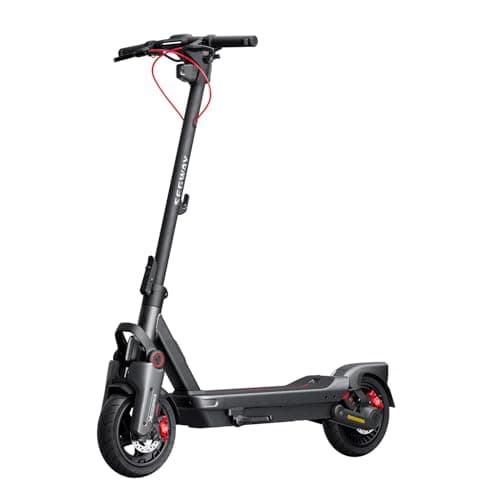 Segway Ninebot Max G3The pick: dual discs with 286 lb of payload, a published IPX6 rating, 11-inch self-healing tubeless tires and 24.9 measured miles. | Best ride quality | 6.1 | $999.99 · View on Amazon #ad How we are funded · Price as of November 28, 2026 |
| 2 | 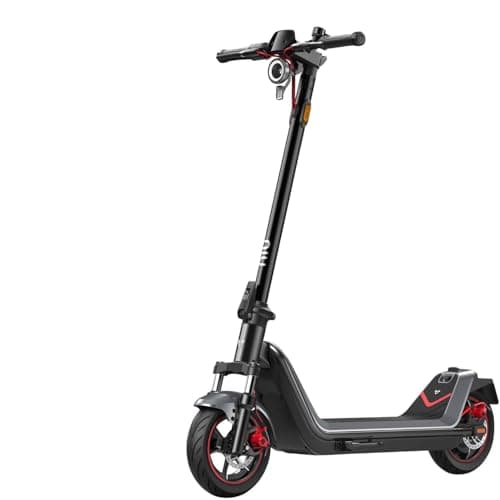 NIU KQi 300XThe budget pick, and the cheapest two-friction-brake scooter in our data: dual discs with 26.8 measured miles at a 265 lb rating. | Best all-round commuter | 5.2 | $369.99 · View on Amazon #ad How we are funded · Price as of November 28, 2026 |
| 3 |  Kaabo King GTRFor riders who have decided on 66 mph. Dual discs on a 137 lb frame, which is the minimum defensible hardware at that speed, not the ideal. | Off-road hyperscooter | 6.4 | |
| 4 |  Nami Burn-E 2 MaxThe range machine: 59.8 measured miles, the longest in our registry, on dual discs and adjustable hydraulic suspension. | Street hyperscooter | 6.5 | |
| 5 |  JackRabbit XG ProFor a seated rider who wants to carry the scooter: mechanical discs front and rear at a claimed 37 lb, on the maker's figures. | Lightest seated machine | 6.2 |
Scores are computed from published specifications using the rubric on our research methodology page. Tap any row to jump to the full write-up.
Every pick in full
Each model below lists what the maker publishes, what an independent tester measured, and the trade-off you accept by choosing it. Nothing here is perfect.
Segway Ninebot Max G3
The pick: dual discs with 286 lb of payload, a published IPX6 rating, 11-inch self-healing tubeless tires and 24.9 measured miles.
- Range:
- 24.9 milesMeasured (eRideHero, Sep 2026)
- Top speed:
- 28 mphMeasured (eRideHero, Sep 2026)
- Weight:
- 54.2 lbMeasured (eRideHero, Sep 2026)
- Max rider:
- 286 lbMeasured (eRideHero, Sep 2026)
What is good
- IPX6 is the highest weather rating in our mainstream commuter set
- 850 W handles 10%+ grades with an average adult aboard
- 286 lb payload gives genuine headroom over the usual 265 lb ceiling
What you give up
- 54.2 lb — folding it is easy, lifting it is not
- 24.9 measured miles is mid-pack despite the hardware
- 28 mph is more speed than most brake setups at this weight want
#ad How we are funded · Price as of November 28, 2026
NIU KQi 300X
The budget pick, and the cheapest two-friction-brake scooter in our data: dual discs with 26.8 measured miles at a 265 lb rating.
- Range:
- 26.8 milesMeasured (eRideHero, Sep 2026)
- Top speed:
- 23.6 mphMeasured (eRideHero, Sep 2026)
- Weight:
- 48.7 lbMeasured (eRideHero, Sep 2026)
- Max rider:
- 265 lbMeasured (eRideHero, Sep 2026)
What is good
- 26.8 measured miles is more real range than most scooters twice its weight
- Dual disc brakes front and rear rather than a disc-plus-regen compromise
- 500 W is the threshold where 8-10% grades stop being a problem
What you give up
- 48.7 lb is a two-hands-and-a-pause lift, not a one-hand carry
- No IP rating published in the test data we found
- 265 lb payload ceiling rules it out for heavier riders
#ad How we are funded · Price as of November 28, 2026
Kaabo King GTR
For riders who have decided on 66 mph. Dual discs on a 137 lb frame, which is the minimum defensible hardware at that speed, not the ideal.
- Range:
- 48.2 milesMeasured (eRideHero, Sep 2026)
- Top speed:
- 66 mphMeasured (eRideHero, Sep 2026)
- Weight:
- 137 lbMeasured (eRideHero, Sep 2026)
- Max rider:
- 330 lbMeasured (eRideHero, Sep 2026)
What is good
- 4000 W will climb any gradient you can stand on
- 48.2 measured miles at a 330 lb payload
- The off-road suspension is the real product here, not the top speed
What you give up
- 66 mph on dual disc brakes rather than hydraulics
- 137 lb
- Not street-legal at these speeds in any US state we are aware of
Nami Burn-E 2 Max
The range machine: 59.8 measured miles, the longest in our registry, on dual discs and adjustable hydraulic suspension.
- Range:
- 59.8 milesMeasured (eRideHero, Sep 2026)
- Top speed:
- 61.2 mphMeasured (eRideHero, Sep 2026)
- Weight:
- 103 lbMeasured (eRideHero, Sep 2026)
- Max rider:
- 265 lbMeasured (eRideHero, Sep 2026)
What is good
- 59.8 measured miles is the longest verified range in this entire registry
- 3000 W with suspension that can actually use it
- 103 lb is light for the performance class
What you give up
- A 265 lb payload on a 61 mph machine is a surprisingly low ceiling
- 61.2 mph is far outside any US street-legal definition of a scooter
- The purchase price is the smallest part of the cost of owning this
JackRabbit XG Pro
For a seated rider who wants to carry the scooter: mechanical discs front and rear at a claimed 37 lb, on the maker's figures.
- Range:
- 48+ milesClaim (Rider Guide, Sep 2026)
- Top speed:
- 20 mph (24 mph off-road mode)Claim (Rider Guide, Sep 2026)
- Weight:
- 37 lbClaim (Rider Guide, Sep 2026)
- Max rider:
- 275 lbClaim (Rider Guide, Sep 2026)
No independent range test for this model has been published as of September 2026. Applying the category’s measured 71% average to the 48 mile claim suggests roughly 34.1 real miles — an estimate from the claimed-versus-tested study, not a measurement of this scooter.
What is good
- 37 lb with a seat — nothing else in the seated category is close
- Real mechanical disc brakes front and rear
- 749 W is more climbing power than most stand-up commuters
What you give up
- It costs more than anything else here, for 20 mph
- 48+ miles is a claim with no independent test published
- It rides like a tiny bike, not a scooter — try before you commit
Listed at $2,249Measured (Rider Guide, Sep 2026) when we read that page. That is a dated figure, not a live one — check the current price before you buy.
Side by side
| Model | Range | Top speed | Weight | Max rider | Motor | Brakes | IP | Price |
|---|---|---|---|---|---|---|---|---|
| Segway Ninebot Max G3 | 24.9 milesMeasured | 28 mphMeasured | 54.2 lbMeasured | 286 lbMeasured | 850 WMeasured | Dual discMeasured | IPX6Claim | $999.99 · View on Amazon #ad How we are funded · Price as of November 28, 2026 |
| NIU KQi 300X | 26.8 milesMeasured | 23.6 mphMeasured | 48.7 lbMeasured | 265 lbMeasured | 500 WMeasured | Dual discMeasured | Not published | $369.99 · View on Amazon #ad How we are funded · Price as of November 28, 2026 |
| Kaabo King GTR | 48.2 milesMeasured | 66 mphMeasured | 137 lbMeasured | 330 lbMeasured | 4000 WMeasured | Dual discMeasured | Not published | |
| Nami Burn-E 2 Max | 59.8 milesMeasured | 61.2 mphMeasured | 103 lbMeasured | 265 lbMeasured | 3000 WMeasured | Dual discMeasured | Not published | |
| JackRabbit XG Pro | 48+ milesClaim | 20 mph (24 mph off-road mode)Claim | 37 lbClaim | 275 lbClaim | 749 W rear hubClaim | Mechanical disc, front and rearClaim | Not published | |
| NAVEE ST3 Pro | 24.9 milesMeasured | 24.8 mphMeasured | 55 lbMeasured | 265 lbMeasured | 600 WMeasured | Drum + discMeasured | IPX5Claim | $599.99 · View on Amazon #ad How we are funded · Price as of November 28, 2026 |
| Varla Eagle One V2 | 24.4 milesMeasuredLogged at 37.8 F with 1,063 ft of climbing — hard conditions, so treat it as a floor | 36.1 mphMeasured197 lb rider | 82 lbClaim | 330 lbClaimVarla's own recommendation is 265 lb or under | Dual 1,000 W (3,200 W peak)Claim | Dual hydraulic calipers, 160 mm rotors, plus electronicClaim | IP54Claim |
Measured figures come from a named third-party test; Claim figures come from the manufacturer. Sources are listed under each model below. Price links are paid affiliate links. Empty specifications read “Not published” rather than being estimated.
The last two rows are the neighbors rather than picks. The NAVEE ST3 Pro runs a front drum with a rear disc — the hybrid, and our pick on the drum page — and the Varla Eagle One V2 runs dual hydraulic calipers, which is the tier above. Read the brakes column, then the max-rider column.
One disc plus regen is one brake
This is the reason the gate on this page is strict. A very large share of scooters at every price point pair a single friction brake with regenerative braking on the other wheel, and list it as though that were two brakes. It is not.
Regeneration turns motion back into charge, and it stops being able to do that when the pack is full — which is precisely the state your scooter is in at the top of the hill you are about to ride down. It also fades rather than failing cleanly, so the warning you get is gradual. eRideHero’s own brake reference is blunt about it: regeneration is not strong enough to serve as a primary braking system (eRideHero, Sep 2026).
Two independent friction circuits means that when one is contaminated, misadjusted or has worn its pad out, the other still stops the scooter. That is the entire argument for this page, and it is why we rank a 265 lb commuter with two cable discs above machines with far more impressive motors. Brakes explained sets out the four hardware tiers, and the safest electric scooters ranks the registry on braking and sealing together.
Cable discs or hydraulic discs?
Both are discs; the difference is what pushes the pads. A cable disc pulls a lever with a steel cable in a housing. A hydraulic disc pushes fluid through a sealed line. Hydraulics need less hand force for the same stopping power, self-adjust as pads wear, and hold their bite through a long descent better because there is no cable to stretch.
Cable discs win on three practical things, which is why they dominate this page. They are cheaper, which is the only reason a 265 lb commuter can carry two of them. They are fixable at the roadside with a 5 mm hex key and ten minutes, where a hydraulic system that has taken air needs bleeding. And nothing about them leaks.
The honest division: if you are a heavy rider, ride long descents, or have settled on a machine above about 35 mph, buy hydraulics — scooters with hydraulic brakes is that page, and the EMOVE round-up covers the brand that fits them to everything it makes. For a commuter under about 28 mph on normal gradient, two cable discs is the right amount of brake and the Max G3 and the KQi 300X are the two to look at.
Where a cable disc runs out
Two of the five picks here are machines where dual cable-style discs are the floor of what the speed demands rather than a comfortable margin. The Kaabo King GTR measured 66 mph at 137 lb and the Nami Burn-E 2 Max measured 61.2 mph at 103 lb, both on dual discs (eRideHero, Sep 2026).
Stopping energy scales with the square of speed, so a 60 mph stop asks roughly nine times the energy dissipation of a 20 mph one from the same mass. At those speeds we would want quad- or dual-piston hydraulics and larger rotors, which is what the Solar Hyperion RST and the Segway GT3 Pro fit (Rider Guide, Sep 2026). Both of those machines are on scooters measured at 50 mph and up, which is the page to read if this is the speed band you are shopping, and essentially nothing in it is street-legal — are electric scooters legal covers the thresholds.
The two are still on this page because they publish the hardware honestly and because the alternative at those speeds is usually a sheet with the brake row left blank. A machine that will not tell you what stops it is worse than one with brakes you can argue about.
What a disc brake asks of you
More attention than a drum and less than you would fear. Pads wear visibly, so inspect rather than diarize: look through the caliper at the pad thickness every few hundred miles and replace before the backing plate touches. Cable discs need the barrel adjuster turned in as pads wear, which takes about a minute.
The two faults riders actually report are a rubbing rotor, which is usually a caliper that has shifted and needs recentering on its mount, and a squeal, which is usually contamination rather than wear — brake cleaner on the rotor and a light sand on the pad face fixes most of it. How to fix electric scooter brakes works through all four faults and names the conditions that should end the ride immediately, and the maintenance checklist has the schedule.
One thing worth knowing before you buy: a bent rotor is cheap to replace and almost impossible to true properly by hand. If you transport a folded scooter regularly, put it in rotor-side up and do not stack anything on the wheel. Repairs, parts and service covers parts availability, which is better for discs than for drums because the pads are frequently generic bicycle parts.
The rest of the brake taxonomy
This page completes a set. There are three friction-brake families in this market and our registry now has a page for each as a complete inventory rather than a selection: hydraulic brakes for the five machines that fit them, drum brakes for the five that publish a sealed drum, and this one for the five with a disc at both wheels. No product appears on more than one of the three.
If you want the hardware ranked against each other rather than listed by type, brakes explained is the reference page. If your deciding factor is the whole safety picture rather than brakes alone, the safest electric scooters combines brake hardware, tire size, sealing and sane speed — and says plainly that only one model in the registry has a measured braking distance at all. And if you are shopping the cheap end, the best scooters under $400 explains why the KQi 300X is the only machine down there with two friction brakes.
What we do not know
Frequently asked questions
▸What is the best electric scooter with dual disc brakes?
The Segway Ninebot Max G3: a friction disc at each wheel, 286 lb of payload rating, a published IPX6 rating, 11-inch self-healing tubeless tires and 24.9 independently measured miles. The NIU KQi 300X is the budget answer and measured more range at 26.8 miles.
▸Are dual disc brakes necessary on an electric scooter?
Two independent friction brakes are. Disc is simply the cheapest way to get them: when one circuit is contaminated, misadjusted or worn out, the other still stops the scooter. A single disc paired with regenerative braking is one brake, not two.
▸Are disc brakes better than drum brakes on a scooter?
Different, not better. A disc sheds heat on long descents, modulates more smoothly and lets you see pad wear. A drum is sealed against grit and standing water and needs far less servicing. Pick for your roads: discs for hills and dry climates, drums for winter grime.
▸Is regenerative braking enough as a second brake?
No. It fades as the battery fills and gives you almost nothing when the pack is full, which is the state your scooter is in at the top of a hill. The brake reference we cite states plainly that regeneration is not strong enough to be a primary braking system.
▸How often do electric scooter disc brake pads need replacing?
Often enough to inspect rather than schedule. Look through the caliper at pad thickness every few hundred miles and replace before the backing plate can touch the rotor. Cable discs also need the barrel adjuster turned in as the pads wear, which takes about a minute.
▸Which cheap electric scooter has two real brakes?
The NIU KQi 300X, which is the cheapest machine in our registry with two friction brakes of any kind — dual discs, with 26.8 measured miles and a 265 lb payload rating.
Read next
Kick & Volt does not ride or bench-test scooters. Every real-world figure on this page is attributed to the third party that measured it — how we research this.